Gail-Anderson Cat

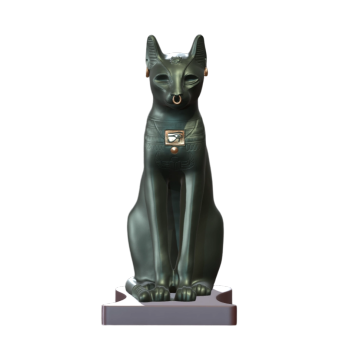
Gail-Anderson Cat

Gail-Anderson Cat is a bronze statue depicting the image of the goddess Buster. The goddess is usually portrayed as a female figure of the head of the cat, or directly in the form of a cat. The main center of worship of the goddess Bast is located in Bubatis, in the Nile Delta. As a maternal goddess, Buster is gentle and kind, in contrast to the more aggressive lioness god, Sehmet. The statue dates back to the late dynasty of ancient Egypt, around 600 BC. Major Robert Grenville Gail-Anderson donated the statue to the British Museum in 1939 and named it in his honor.
Dendra Zodiac relief (3D printable)

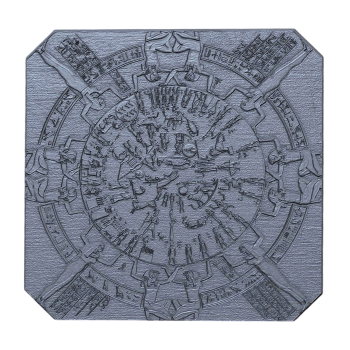
Dendra Zodiac relief (3D printable)

The "relief of the Zodiac in the Louvre" is an important relic of astronomical art in the late ancient Egypt (Ptolemaic period, about the 1st century BC-the 1st century AD). It was originally an "astronomical ceiling" decoration of the Temple of Dendra (Temple of Dendera) in Egypt. This group of reliefs is famous for accurate astronomical observation and mysterious religious symbols. It is a typical representative of the fusion of "astronomical calendar-theocracy" in ancient Egypt. It is now hidden in the "Egyptian Art Department" of the Louvre (Musée du Louvre) in Paris, France ".
Statue of Bodhisattva in the Northern Song Dynasty

Statue of Bodhisattva in the Northern Song Dynasty

This painted stone statue of Bodhisattva during the Northern Qi Dynasty (550-577) is one of the important collections of the Asian Art Department of the Metropolitan Museum of Art (The Metropolitan Museum of Art) in New York, USA. This statue is famous for its style of "showing bones and clearing images", which perfectly combines the influence of the "Central Plains" of Buddhist art in the Northern Qi Dynasty and the "Matura style of the Gupta Dynasty in India". The Bodhisattva is "upright", with its feet slightly separated, its center of gravity falling on its right foot, its left foot naturally extending forward, and its body slightly lateral, forming a dynamic balance.
Spanish seventeenth-century blunderbuss

Spanish seventeenth-century blunderbuss

One of the core physical evidence of Spanish military history, focusing on the development and military application of firearms technology in Spain in the 17th century. These firearms are not only the material carrier of the military hegemony of Spain's "Golden Century" (1492-1700), but also the key witness of the transformation of modern military technology in early Europe, bearing the multiple historical connotations of "imperial expansion", "technological innovation" and "war memory.
Spanish eighteenth-century blunderbuss

Spanish eighteenth-century blunderbuss

This firearm is one of the core physical evidence of Spanish military history, focusing on the development and military application of firearm technology in Spain in the 18th century. These firearms are not only the material carrier of Spain's "golden century" military hegemony, but also the key witness of the transformation of modern military technology in early Europe, carrying the multiple historical connotations of "imperial expansion", "technological innovation" and "war memory.
Spanish sixteenth-century short-tube blunderbuss

Spanish sixteenth-century short-tube blunderbuss

The sixteenth-century short-barrelled firearm is one of the core material evidence of Spanish military history, focusing on the development and military application of firearm technology in Spain in the sixteenth century. These firearms are not only the material carrier of the military hegemony of Spain's "Golden Century" (1492-1700), but also the key witness of the transformation of modern military technology in early Europe, bearing the multiple historical connotations of "imperial expansion", "technological innovation" and "war memory.
Spanish sixteenth-century blunderbuss

Spanish sixteenth-century blunderbuss

One of the core material evidence of Spanish military history, focusing on the development and military application of firearms technology in Spain in the 16th century. These firearms are not only the material carrier of the military hegemony of Spain's "Golden Century" (1492-1700), but also the key witness of the transformation of modern military technology in early Europe, bearing the multiple historical connotations of "imperial expansion", "technological innovation" and "war memory.
Late 19th century Spanish lieutenant-general side cap

Late 19th century Spanish lieutenant-general side cap

This "Lieutenant General Side Hat (1869-1876)" is one of the treasures of the Spanish National Military Museum (Museo Nacional de Historia Militar, Toledo). Its history can be traced back to the Spanish military system reform in the middle and late 19th century. Critical period. As a headwear specially designed for the rank of lieutenant general (Lieutenant General), it is not only a visual symbol of Spain's "military hierarchy", but also a vivid witness to the integration of European military modernization and local culture in the 19th century.
Flat iron at the Stranraer Museum

Flat iron at the Stranraer Museum

This seemingly simple tool is not only a practical object of daily life, but also a "micro window" to observe the folk culture of Victorian (1837-1901) Scotland ". Flat iron (Flat Iron) is the most mainstream clothes finishing tool in the 19th century before the industrial revolution, its design is simple but the function of the key-by heating the metal surface, the use of pressure to remove clothing wrinkles. Before the popularity of steam irons (invented at the end of the 19th century), flat irons were the "essential artifact" for housewives, tailors and laundryers ".
Crossbow

Crossbow

This crossbow is in the collection of the Stranraer Museum.
Stranraer Museum-Boar Skull

Stranraer Museum-Boar Skull

A thousand-year-old olive tree trunk

A thousand-year-old olive tree trunk

Cyprus is known as the "Olive Island", its olive tree cultivation history can be traced back to the Bronze Age (about 3000 years ago), there are many ancient olive trees. Collected in the Medieval Museum of Limassol.
blue whale skeleton

blue whale skeleton

The blue whale (scientific name: Balaenoptera musculus) is a marine mammal in the family baleen whales. There are 4 subspecies. The blue whale is considered to be the largest animal known to have ever lived on the earth, reaching a length of 33 meters and weighing 181 tons. The blue whale has a long, thin body and a bluish gray back, but it sometimes looks lighter in the water. The blue whale's flippers are 3-4 meters long. Gray above, white on narrow sides. All white below. The head and caudal fins are generally gray. But the back and sometimes the flippers are usually variegated.
Painted pottery plate relief

Painted pottery plate relief

This relief is the collection of the Poole Museum, painted pottery plate is a low temperature tin glazed pottery, originated in the 15th century Italy Faenza (Faenza), after widely popular in Europe (such as France, Germany, Britain, etc.).
Della Robbia Family Tin Glazed Pottery Relief

Della Robbia Family Tin Glazed Pottery Relief

This relief is in the Poole Museum. Della Robbia is a famous Italian Renaissance art family, famous for its tin glazed pottery relief (Terracotta Relief).
Iranian Minai Pottery Depicting Sitting King's Bowl

Iranian Minai Pottery Depicting Sitting King's Bowl

Mina' I ware is a very famous ceramic craft in Iran in the 12th century, famous for its exquisite decoration and rich painted patterns. This pottery combines the unique aesthetic of the Islamic world with superb craftsmanship and is used to show social status or religious stories. Minay pottery depicting the bowl of a seated king, 12th century AD, currently in the collection of the Minneapolis Institute of Art.
Khmer Empire Cultural Heritage Shiva-Vishnu Statues

Khmer Empire Cultural Heritage Shiva-Vishnu Statues

This statue was created around 600 AD and unearthed in the Phnom Da region of Cambodia. Its material is sandstone with gilded decoration, showing the delicacy and splendor of Khmer art at that time. This artistic style conveys the profound influence of Indian culture in Southeast Asia, while also reflecting the unique aesthetic and religious beliefs of the Khmer Kingdom. It is 173cm high, 75cm wide and 23cm thick. It is now in the Gimmy Museum of Asian Art, Paris, number MG 14910
Indian 13th Century Sculpture Krishna Bronze Statue

Indian 13th Century Sculpture Krishna Bronze Statue

This is a bronze statue of Krishna from the southern Indian state of Tamil Nadu. This statue reflects the image of Krishna, one of the incarnations of the Hindu god Vishnu. Krishna is not only a deeply worshipped god in Hinduism, but also an important role in the epic Mahabharata. This sculpture has been identified as a cultural relic from the 13th to 14th centuries and is currently preserved in the Museum of World Cultures and Peoples in Barcelona, Spain. It is not only a symbol of Indian culture, but also an important heritage of cross-cultural communication.
Classical period artifacts Klatt wine

Classical period artifacts Klatt wine

Glass-shaped Kratt wine ware decorated with red figures, Sicily La Gusa. Front: The warrior bids farewell to his family (wife and son in the arms of a nanny); Back: The man, armed with a stick and Himatian, stands between two women. From the site of Kamarina, Lagusa Province, Sicily, Italy. Classical period, 5th century BC. Collected in the Parco Archeologico di Kamarina e Cava d'Ispica Archaeological Park.
Hindu Cultural Heritage Shiva and Parvati
Hindu Cultural Heritage Shiva and Parvati

This is a Shiva and Parvati (Uma-Maheshvara) statue, made of sandstone, was created from the 10th to 11th centuries AD, and is currently in the collection of the Minneapolis Art Institute. In South Asian sculpture, Shiva (Shiva) and Parvati (Pārvatī) appear in a variety of image forms and incarnations. In this sculpture, Shiva is depicted as the 'Great God' (Maheshvara), while Parvati appears in the image of 'Uma' (Uma), the daughter of the mountain king.
Thailand prehistoric period artifacts Thailand prehistoric pottery jar

Thailand prehistoric period artifacts Thailand prehistoric pottery jar

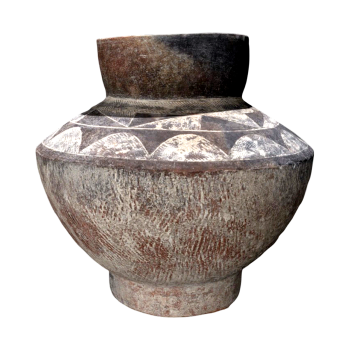
This clay pot is a typical artifact of Thailand's prehistoric period, reflecting the daily life and craftsmanship of human beings in the Neolithic or Bronze Age at that time. This type of pottery is mainly used to store food, liquid or grain, reflecting the needs and skills of an agricultural society.
South Indian Religious Cultural Heritage Sumerskanda Statue

South Indian Religious Cultural Heritage Sumerskanda Statue

A statue of Sumo Scanda (Somaskanda), dated from about the 14th to 15th centuries AD. "Sumoskanda" is a religious scene in Hindu mythology that depicts the image of Shiva (Shiva) together with the goddess Parvati (Parvati) and their child Skanda (also known as Murugan Murugan). This scene usually symbolizes the harmony and divine strength of the family. In such statues, Shiva and Parvati sit in the center, showing majesty and solemnity, while Skanda stands in the center or near between the two as their children.
Late Mughal Empire Mughal Art Mughal Wind Flower Decorative Relief

Late Mughal Empire Mughal Art Mughal Wind Flower Decorative Relief

This relief is an outstanding representative of the late Mughal art, unique style, no longer the pursuit of symmetry in the early design. The work depicts the irises in banana leaves swaying in the wind, and the design is full of imagination. The pattern of banana leaves grows from three layers of spiny thistle leaf ornaments (acanthus leaves), and the composition is vivid and dynamic. The relief is made of mottled red sandstone, typical of the Mathura, Sikri and Chunar regions of northern India. Another part of the artwork (the associated panel) is now in the Louvre in Paris.
Iranian cultural heritage Minai pottery depicting bowls of a woman riding an elephant

Iranian cultural heritage Minai pottery depicting bowls of a woman riding an elephant

This is a Minai pottery "Bowl depicting a woman riding an elephant", created in the 12th to 13th century AD, currently collected at the Minneapolis Institute of Art. Minai pottery, which originated in Iran, is a fine piece of medieval Persian ceramic art and is famous for its exquisite colorful decoration. This bowl depicts the scene of a woman riding on an elephant, showing the high integration of life and art. This work reflects the social style and artistic level of the time, and is an important material evidence for the study of medieval Islamic art and culture.
1 2 3 4 5 6 7 8 9 ... 19 Next